Engineering & STEM
Mechanics, forces & materials
Calculate a moment, draw a free-body diagram and compare material properties with practical examples for introductory engineering study.
Draw the forces before reaching for a formula
Sketch a crate at rest on a horizontal conveyor. One arrow points down from its centre to show weight. Another points up from the belt to show the supporting force. With no vertical acceleration, these balance. When the belt begins to accelerate, friction can act forwards on the crate and accelerate it too. A force diagram shows forces on the object you selected. The force the crate exerts on the belt belongs on a separate diagram of the belt.
If the horizontal resultant force on a 4 kg crate is 12 N, its acceleration is 12 ÷ 4 = 3 m/s². If a 12 N drive force is opposed by 4 N of resistance, the resultant is only 8 N and the same mass accelerates at 2 m/s².
Turn a handle
A force produces a moment about a pivot when its line of action passes some distance from that pivot. Multiply force in newtons by the shortest perpendicular distance in metres. A 30 N push at right angles to a 0.20 m handle gives a moment of 6 N·m. A push along the handle through the pivot gives zero moment, even if the force is large.
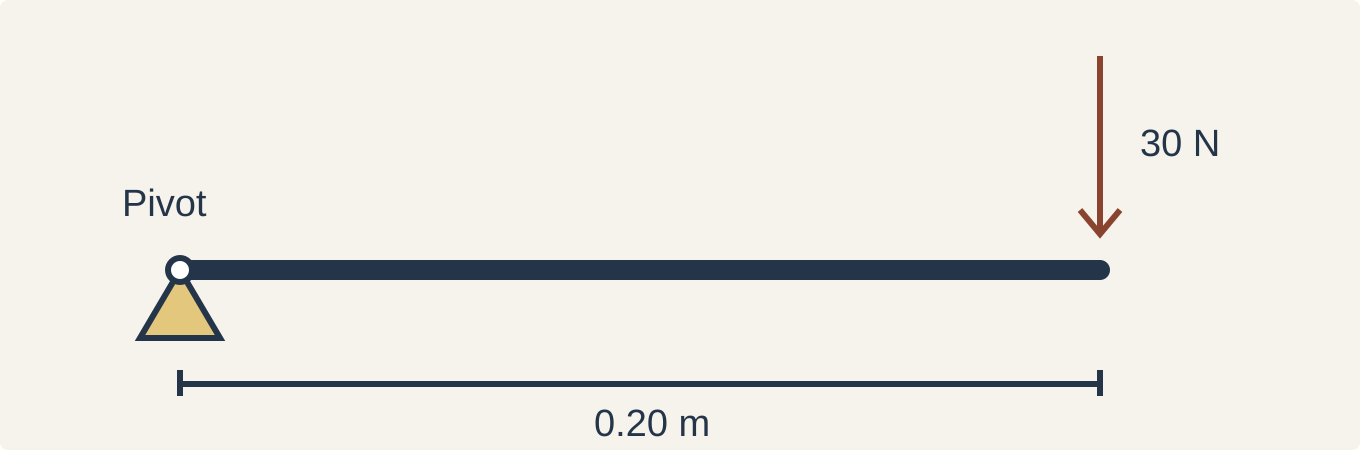
To balance a 6 N·m clockwise moment with a force acting 0.15 m away, apply 6 ÷ 0.15 = 40 N in the direction that gives an anticlockwise moment. This balance describes rotation about the chosen pivot. When checking complete equilibrium, also account for the forces at the support.
Choose a material for the handle
Stiffness describes resistance to elastic deformation. Strength concerns the stress a material can withstand before yielding or breaking. A handle may bend too much for comfortable use even if it never reaches its yield stress. Density affects the mass of the finished part, while corrosion and surface finish matter if it will be used outdoors.
Fold a strip of paper lengthways into a channel. Compare its sag with a flat strip of the same paper spanning the same gap under the same small load. You changed the section shape while keeping the material and approximate mass constant. Record the span, load and orientation so somebody else can repeat the comparison.
Sources and further reading
- AQA GCSE Physics | Forces and moments · Checked 2026-11-08